Friday, 22 May 2015

Gilly Thomas page updated

16.6.15

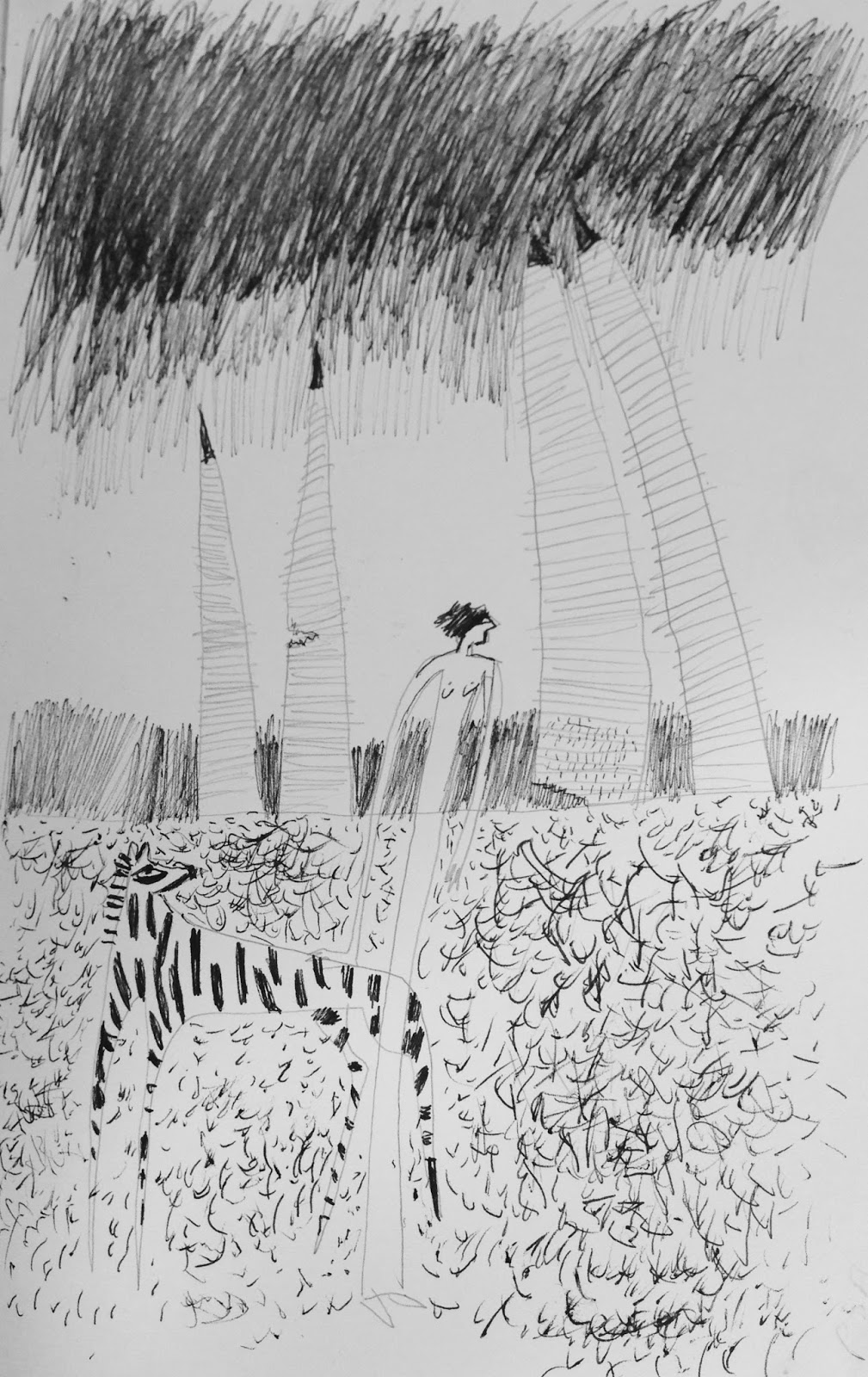
I don’t much like my last picture – so neat and tidy.
I prefer this.

In one of the infinite probabilities of the multi-verse, scarily this is actually happening.

Flap Flap the Big Wings


I am a long long way from squeezing oil paint in my fist straight from the tube onto a surface.

I don’t strike the picture like a murderer stabs a victim, or crush the paint out into slashes.

Karel Appel did. He paints like a well angry man. Not always, but definitely when he made The City, letting go of the skills he surely had. He purposefully relinquished them, not even allowing himself a brush in the old film I saw of him working.

Just the inch wide top of a 10inch tube that he squeezed from the middle to the sounds of some postmodernist jazz.
Cool. But I wouldn’t want to share the toothpaste with him.

Attempting to bounce off Karel Appel is like trying to share a head

Sharing a Head


Artistic Risk

Sounds ideal to me, probably rarely fatal. But a cluttered mind provokes external hoovering. If there were flies in your head as well as on the window ledge it would become unbearable....
Got to remember – however bad things are they can always get worse.


22July 2015


I just discovered this word UHTCEARE
It means pre-dawn anxiety in Old English and is nothing to do with ultra heat treated milk which is also horrible and the ruination of tea. I could make good use of this word most days.

A also just read ‘Fludd’ by Hilary Mantel – a perfect book. Strangely the main character is a faux priest who may be an angel, or perhaps an alchemist, of possibly the Devil.

And oddly, the effect he has seems to be to rescue an unbelieving real priest and a sad ‘professed’ nun. But here’s a funny thing – nobody can say what he looks like even while they’re looking at him, and the food on his plate disappears but nobody sees him actually eat it. He drinks whisky but the level in the bottle never goes down.

In the same way the Appel woman and her creature stand over the city, and no one sees her coming and no one sees her going. And she’s far too fey to eat anything I’m sure.
But suddenly she comes and suddenly she goes.

Here she isn’t


1 Sept 2015

She’s an enigma to me still

I saw her once, I can see her now


What’s with the arms?
A magical gesture?
A congenital malformation?
A peculiar valediction?
A horribly secret sign?
What do you symbolise?
O Servant with white gloves?

And where, may I ask is everyone else?


18 Sept 2015

And what about the skyline of the city? Like Venice, conjured but not understood. And what about writing in the style of a forgotten poet, probably dead, whose work I knew well when I remembered anything at all.
The world, my world, my city, spins around me at night while I lie still. Or I spin and the world doesn’t. Not good either way.

RELICS WILL DROWN


This may be my final image.

The drowning city – not a metaphor – a drowning city.
All relics will drown.
The Appel woman and her whatever-it-is survive to see the 11th Century abbey adrift and awash. Lights still blaze from the wobbly gherkins of a flawed modernity. The sea roils more as it reaches the walls.

You can be as solid as you like – one day the waters will close over your spinning head.

All relics will drown.

The Great Filter may have already been and gone, or is waiting somewhere along Time’s Arrow.

Ponder the Fermi Paradox.

Some relics will drown before they even become relics because they didn’t have time to become relics.
Waves come in various forms. We have to watch out for them, mythic or mundane. Afterwards there will be no relics, and not even a solitary angel with stunted wings to worship, and no worshippers either.

There is another witness who stands beyond the 4th wall, the invisible wall through which the viewer gazes from a lofty place, with wisdom, indifference and powerlessness in equal quantities.
THIS IS KAREL APPEL’S WOMAN 


I SUSPECT WE MOVE TOWARDS A TIME WHEN EVEN IDIOTS ARE NO LONGER HAPPY


**********************************************************

So here I am, still in Appel land and trying to connect with my inner WILD.


But just standing here trying.

I’m thinking about Guardian Angels. What are they like?

I suspect they’re on their i-phones constant, where all messages languish forever on unanswered voicemail.

Do we each have one? Or are they like the Macmillan nurse who never turns up? Where are they when you need them?

Are angels impotent like Appel’s viridian monstrosity?

continued on Gilly's page

Tuesday, 12 May 2015

John Renshaw page updated


Currently continuing the struggle, exploring issues arising out of the paintings of Morandi. Although small drawings and painting continue, I have also, quite recently considered making some work in three dimensions using  ‘found’ objects and ‘found’ pieces of wood.


continued on John's page

Wednesday, 6 May 2015

Marged Pendrell page updated

My main focus this month has been on Material in particular the peat which I collected from Rhosydd bog on 25/03/15 and has been drying in my studio ever since.

I began experimenting both in 2D and 3D:


I began by working on paper both in the journal and in a larger drawing (which is in progress) .

I found that there were subtle differences in colour and texture according to location.


I worked one layer upon another exploring the contrasting qualities of lightness and fluidity on paper as opposed to the density and darkness of the material in solid form. This is ongoing, left for now as I am not sure how or if to push it further.

Continued on Marged's page

David Jones

Iwan Lewis is looking at Elephant by David Jones.


David Jones Elephant. 1928. Oil on Canvas 51 x 69 cm
(c) The National Museum of Wales / Amgueddfa Cymru


Continued on Iwan's page

Friday, 17 April 2015

Noelle Griffiths page updated


Noƫlle Griffiths has chosen to work with the painting

‘Ligeia’ acrylic on cotton duck; 244x216cm; 1978 by John Hoyland (1934-2011)


Studio March 2015
 

I have chosen this painting as a starting point for the RE-TAKE/RE-INVENT exhibition for the following reasons:


John Hoyland was my external assessor in 1982 when I graduated from the Painting Department as St Martin’s School of Art, London.  I never met him, but he was friends with most of the painting tutors and well known as an artist.


Like many of my fellow students I reacted against his large ‘macho’ abstract paintings.  The exhibition ‘A New Spirit of Painting’ was hugely influential when it was shown at the Royal Academy in 1981, and I was drawn to emerging artists such as Mimmo Paladino, Sandro Chia and Julian Schnabel.  I was contextualising my own work with historical artists such as Paul Gauguin, Franz Marc, Ernest Ludwig Kirchner, Max Beckmann and I have always loved the paintings by Mark Rothko.  Amongst the students was an awareness and criticism of the male dominated abstract world of painting.  We had a diverse range of tutors and visiting artists, some of the female artists were Jennifer Durrant, Eileen Cooper, Claire Joy, Tricia Gilman.  As students we talked about how to make paintings that were visibly painted by a woman.
 
......continued on Noelle Griffith's page

Thursday, 9 April 2015

Marged Pendrell page updated


Post  2 – Marged Pendrell

Looking at Long’s’ Blaenau Ffestiniog Circle’ there is a predominance of triangle forms which I also noticed on my walks through the quarries, occurring both as waste and naturally (in their crystalline structure).

For the past year I have been working on a flotilla of small boats as a connection to the land on which I live and the studio in which I work. I am thrown back into this as I walk and collect slate waste for my first circle...

Continued on Marged Pendrell's page
 

Tuesday, 31 March 2015

Fuseli : Anticleia


Wanda Zyborska


On the first visit on 12 December 2015 I went looking to see what is on the walls of the public galleries.  I am making work about the representation of older women, and I wanted to see how many and what sort there might be in public, not hidden in the vaults.  There weren’t many; a few portraits of wives, opera singers and one of the Davies sisters from Gregynog, Margaret (described as ‘a profoundly sympathetic image of a woman at the onset of old age’, I’m not sure why), and that was about it, apart from a satirical cartoon of Lloyd George as a ‘Welsh old lady’ and a Frenchman, seen as equally dreadful things by the cartoonist Edward Tennyson Reed , who was ageist, sexist and racist all in one.  The caption underneath reads:


‘Cer-taine lee!  I am altogezzer vat you call a French!!  Voyez-vous, I just put on ze ‘at of ze Velsh old La-dy and it make a vairy nice  top-at of ze boulevardier, n’est ce pas?!!”


The painting that most interested me is by Fuseli, taken from Greek mythology; Teiresias foretells the future to Odysseus, 1780-85. A grey, wraithlike woman wilts between two men.  Too etiolated to have many distinguishing features, her age is uncertain, but the label said that she was Odysseus’s mother. Although also dead, Tiresias is depicted in as corporeal a way as Odysseus, but his mother is almost invisible, in monochrome, her arms still crossed over her chest as if she is still in the coffin and has no energy even to move. 


Thinking about it on the long drive home with Andrew and Noelle I still wasn’t sure if I had finally chosen my work, but now I know it is right.   The more I find out about it the more I am charged by my choice.

 
Anticleia       


Anticleia, maquette, February 2015


Further research told me that the woman’s name was Anticleia (literally ‘without fame’).  She was the daughter of Autolycus and Amphithea and mother of

Odysseus by Laertes (though some say by Sisyphus, who seduced or raped her because her father had stolen his sheep).  She was the granddaughter of the god Hermes who was the father of her father.  She is defined by her family relationships, mostly masculine, and only appears in this section of the Odyssey as a cypher to let Odysseus know what is going on at home with his wife and son. 


I hadn’t expected many examples of older women, perhaps a few crones, and I was right. Anticleia is perfect for my purpose, as a suitable representative of invisible, underestimated and overlooked older women (like me).


Henry Fuseli Teiresias Foretells the Future to Odysseus. c.1800. Oil on canvas, 91 x 77.8 cm.
(c) Amgueddfa Cymru / National Museum of Wales


Anticlea Elegans
 
There is a single flower named after her, Anticlea Elegans, or Mountain Death Camas, a small white lily whose flowers are extremely poisonous (pictured here).


I have made a drawing of the whole painting and 4 maquettes, 3 of Anticleia on her own, and one of the group of three. 
 
Tiresias Foretells the Furture to Odesseus, maquette. March 2015


I will go back to the museum and draw the original, which might be a bit difficult as it hangs in a sort of corridor.  I want to spend more time there, to get more of a feel for the place.  It was lovely visiting the museum with the others and going into the vaults and closed rooms.  I love the way a place feels different when I am visiting it in a different role than the usual one. I feel more involved with it, more curious about it and more noticing. This engagement with the place is important to me. It is the connections I make, real and imagined, between my own practice and the chosen art work, its history and the concepts it embodies, the people and the building that will feed my work.